Sunday, 1 July 2012

Kili Team Training 101: Part 2

In Part 1, we explored the importance of finding a trainer, getting used to uncomfortable conditions, breaking in the gear and going on hikes. Here's a snapshot of some of our other training tips. 

Westcliffe after sunrise
Training Tip # 6: Climb the Westcliffe stairs
One might think that being born and bred Jo'burgers, many of us would have a distinct advantage when adapting to high altitudes, having lived all our lives at 1753m above sea level (only about 250m below the start of the Kili climb). Well, that remains to be seen. Apparently it's possble to train your body to adapt to high altitude in very sophisticated and expensive ways. You can hire altitude sleeping and workout systems designed to train you to cope with oxygen deprivation. Or you can just do what we're doing which is hike as often as possible and engage in interval training. Many people experience some form of altitude sickness on the mountain - whether it is shortness of breath, nausea, loss of appetite, poor quality of sleep or headaches. When people ask me if I am training to adjust to high altitudes, I think of the symptoms of altitude sickness - in particular the shortness of breath and the nausea and how I feel after I've climbed the Westcliffe stairs a few times with my backpack on. 'Definitely!' I say.

Training Tip # 7: Streeeeeetch
Anyone will tell you that stretching after exercise is really important. Stretching helps to increase your flexibility, prevent injuries, limits muscle soreness (although I have to say, I have seldom experienced this particular benefit!), improves athletic perfrmance (ok, if you say so) and (supposedly) improves circulation (those mornings I've forgotten my gloves, my fingers feel as though they will develop frostbite within the hour). Actually, one of the most amazing things about this expedition, is that the journey is taking place just as much internally, as it is in our every day lives, if not more so. If it's true that the Kili team is stretching leg, back and arm muscles, it's just as true that we are stretching our minds and our hearts to accommodate this beautiful adventure. As we call into action dormant flexors and extendors, there is an awakening that seems to be taking place spirtually, emotionally, intellectually, socially. It's true that when you open yourself to change, even if initially, the opening is only as big as the eye of a needle, the universe will conspire to do the rest. In the truly open spaces where we let ourselves be responsive to new experiences, light shines into those unexplored places and infuses every day with brand new meaning.


Kili Team on Linksfield Ridge


Training Tip # 8: Push your limits; extend your boundaries!
It was a Monday morning. Tshepo had us doing hill sprints on Long Ave, the road that runs up past my children's school. He had told us that we were to sprint as fast as we could past three lamp posts. Turn around walk back 1/3 of the way and jog the rest of the distance to the bottom. Repeat for 40 minutes. I was doing beautifully. By then we'd been training for a few weeks and my running experience from last year was kicking in. I was finding the work challenging but not unpleasantly so. Three lamp-posts, that was my goal, my focus, my limit. All at once, there was Tshepo sprinting along next to me. Casually, he said, 'You're going to run to the next one.' My first thought was 'Oh no I'm not! I can't possibly. Three was my limit'. I turned my head just to confirm I hadn't misheard, my heart was pounding pretty loudly, maybe I was mistaken. Please G-d let me have been mistaken. 'Do four.' Tshepo smiled. 'Not possible', I said to myself again, now acutely aware of just how laboured my breathing was, how tired my legs felt. 'Says who?' asked another voice from inside my oxygen deprived brain. 'Who ever said three was your limit?' So I pushed. I kept running, even though I felt like my lungs would combust or I would collapse or have a heart attack. I ran the extra distance, just as fast as I could strain every sinew in my body to go. I went beyond my comfort level, because my trainer thought I could and because he thought so, I believed it too. The distance wasn't important. The speed wasn't either. The lesson was just this. We are so often more capable than we give ourselves credit for. I'm nervous about summit night. It will be cold, it will be dark, it will be a long night and a hard climb. I will be tired and possibly suffering from altitude sickness. I think though, that if I can put myself back on Long Ave moving up the hill towards one more light, then in the midst of exhaustion and possible despair, I might just manage to keep going to sunrise and the crest of a new day.
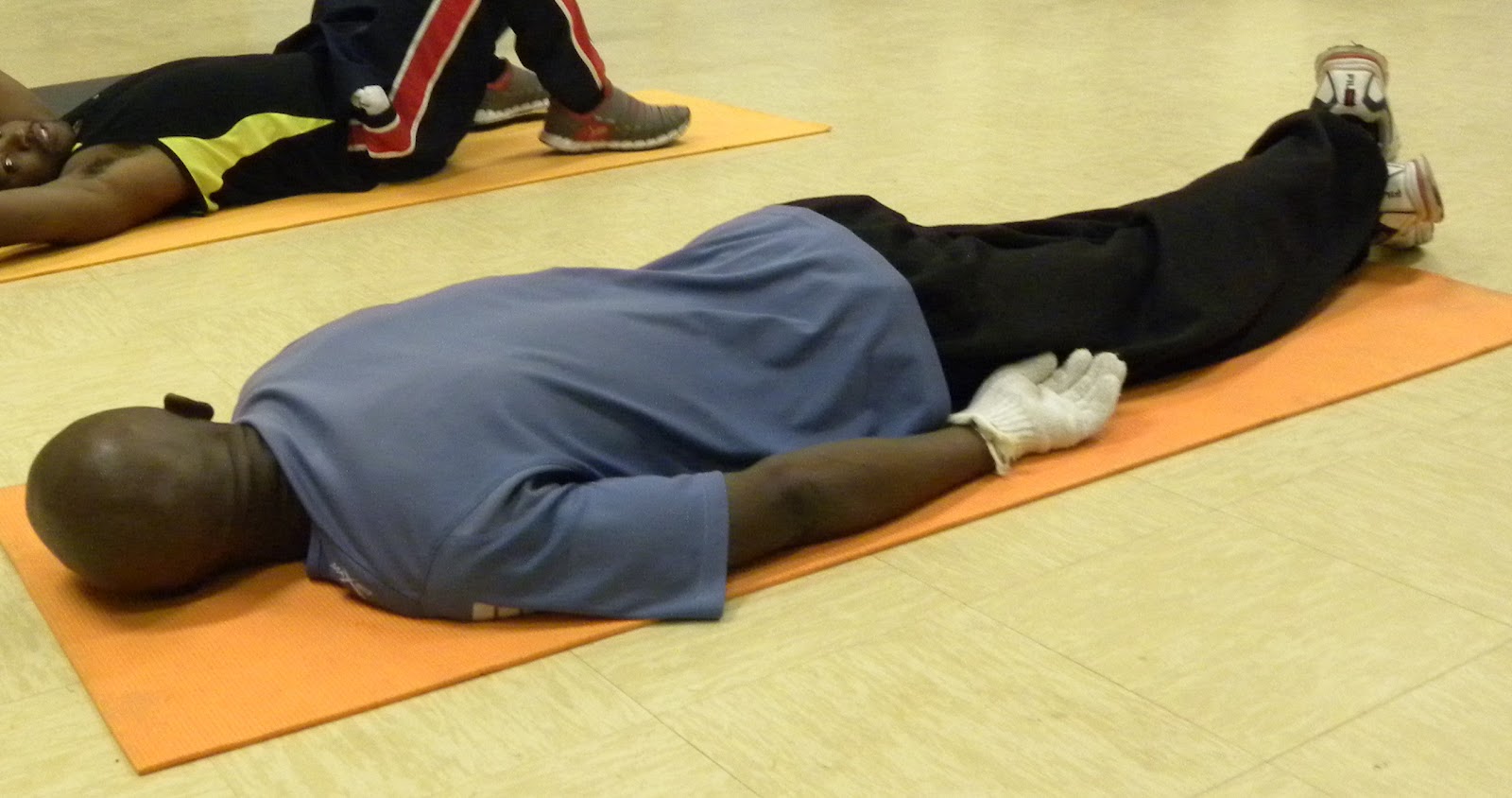
Our trainer Lucky recuperating after one of our "Crank It" sessions

Training Tip # 9: Strengthen your core
Core strength refers to the muscles of your abdominals and back and their ability to support your spine and keep your body stable and balanced. Important when you're climbing to almost 6000m with a 35 litre backpack. At least twice a week, and usually more often, the Kili team is hard at work doing one legged squats, walking lunges, weight lifts, balancing, bridge and plank positions, stomach crunches, step ups, push ups, the list is pretty much as endless  as the exercises feel when you're doing them. All this to develop and sustain core strength to support your spine. Well to me the metaphor is a pretty obvious one. As my muscles tighten and tone, as I hobble and limp from one training session to the next, I draw comfort and support from my own core. The central force that holds my world together - no, not coffee! My family and friends. If it weren't for their unconditional love and encouragement, I think I might be pretty spineless in the face of some of our upcoming challenges. For all of us, there is an internal motivating drive. But what makes the reality of it all a little less confronting and for me more manageable are the stablising forces external to myself.  My children keep me grounded, my husband keeps me motivated, my parents keep me inspired, my siblings keep me determined and my friends keep me encouraged. Also, how would I ever face them all again if I didn't make a success of this after all the noise we've made about it! There is actually a reason Kilimanjaro is called "Everyman's Everest". True, the climb is accessible to most people and with a little will and preparation, mostly anyone can manage the climb. We've seen footage of climbers who are blind or  even legless summit. But it is a challenge nonetheless. When you take on something like this, it really helps to strengthen your core, and to have your own core of loved ones, embrace and strengthen you.

Training Tip # 10: Have amazing team mates
So here we are - 20 women, as diverse as we can be: married, single, mothers, daughters, with different religious, ethnic and cultural backgrounds, women in our twenties, thirties and forties. What we had in common was a dream to climb to Uhuru Peak. But as I train, hike and sit in meetings with these incredible women I am struck again and again by how fortunate I am to be counted among their numbers. There is a vibrancy expressed in razor sharp intelligence, a wealth of warmth and comeraderie, a genuineness in the care extended to one another. There is an abundance of fun and an openness to joy that is intoxicating. There is a willingness to venture into the unknown and a shared promise of a quest yet to be articulated and discovered. It is a group open to new experiences and changes, anchored by common sense and practicality but set aloft on the wings of dreams and anticipation.  Everywhere I look I see bravery, integrity, commitment, faith. These women are bold, bright statements of how life can and should be lived. It is an honour and privilege to be among them. If you're going to climb a mountain, have good climbing partners. Although I had no hand in choosing mine, I am filled with gratitude and gladness; humility and happiness that G-d put me in this place, at this time. The only place to go from here, is up.

by Tali Frankel

Team Kili: Partners in climb and life


Kili Team Training 101 - Part 1

One of the questions I think I have been most frequently asked since taking on the Kili challenge is, "So, how do you train for something like this?" People seem genuinely interested while you talk about the gear and the beautiful hikes we've had the opportunity to go on. Then I watch as their eyes glaze over as you discuss walking lunges, squats, dead drops with 20kg of weight in your hands, the 4:30 a.m. wake-ups, the repetitive climb up the 200 odd Westcliffe stairs. They shake their heads, look at me with a mixture of wonder and wariness and say, "You're actually insane!" They may be spot on. I can tell you though, that Amanda is right when she says that there is something extremely compelling about working towards a specific goal, which allows you to do things you never thought yourself capable of. Like climbing the Westcliffe stairs, repeatedly, in the dark at 5:00 a.m. when the temperature gauge in your car reads 1° C. 

The Westcliffe Stairs at 5:00 a.m.
So for anyone interested in what you need to do in order to be able to climb a mountain, here are some of the things we've learned along the way:

Training Tip # 1: Find a trainer
Interestingly, this is not a new concept to Jews. One of the first mishnahs our children learn at school goes "Make for yourself a Rav". Whatever journey we're on - be it physical or metaphorical, always, always, take a guide. The Kili team has several - firstly there's Lance our tour operator and guide on the mountain. Without ever having actually met the man in person, he has imparted a wealth of knowledge and wisdom through his email correspondance, skype sessions and for me most importantly, through watching a video recording of his first ever meeting with the team. We're in safe, experienced hands, and that is more reassuring than you can begin to imagine.
As far as actual training goes, every one is hard at work. Below, is a picture of Tshepo Khoza, (far left) the founder and director of "Art of Running" and his trusty associates (from left to right) Lucky, Thabo and Sipho who are available 3 times a day Monday - Friday to train us in groups. Thank goodness for Tshepo's expertise, Lucky's encouragement, Thabo's constant, entertaining commentary and Sipho's quiet faith in us all. Together they have pushed us well beyond our levels of comfort and into a brand new zone where we are stronger, fitter, more confident and surer than we ever thought we could be in just a few weeks.  
Tshepo, Lucky, Thabo and Sipho


Training Tip # 2: Train in the dark
Training for most of us takes place before the sun rises, or as the sun is setting. Most of us work, and if we're not formally employed, we're mothers. There is very little time during daylight hours for donning lycra and takkies. I guess it also helps to acclimatise to the fact that the toughest part of the climb - which is when we summit, takes place throughout a night of climbing. We've been told that the summit attempt takes place at night so that you don't freak out when you see where you're going. If you could actually view your precarious location, you would be paralysed by terror. I prefer to think it's so that we can summit at dawn and greet morning on the 'Roof of Africa' - much more poetic.

Training Tip # 3: Train in the cold
The summit of Kilimanjaro is very cold. As in -26° C cold. Best you check out your gear before you board the plane. The advantage of having to train through winter is that you get to prepare for sleeping in sub-zero temperatures with nothing but your base layer and sleeping bag to protect you. In a way I'm grateful when the thermometer dips below freezing becuase it gives me a chance to see if the cold gear really works. And you know what? It does!

Training Tip # 3: Find a good parking lot
We spend a lot of time outdoors at un-Godly hours. When we first started, our meeting  place was in the parking lot just outside Shula's bakery. Now we seem to do much of our stretching in the parking lot at Yeshiva College. I once met the president of our shul on a Sunday morning outside Shula's. He was buying doughnuts. I was with the team, stretching after a gruelling 45 minutes of interval training up and down Bradfield Drive. See here's the thing about parking lots - they're very public places. If the encounter hadn't happened right there, out in the open, and been reported to mutual acquaintances, not even I would have believed it to be true. Me? Outside a bakery on a Sunday morning stretching instead of buying freshly baked goods?? After 45 minutes of running??? Rubbish!

Training Tip # 4: Break in the gear
No question about it, you have to get used to the gear. Boots and backpacks are your companions literally every single, agonisingly slow step of the way. Getting comfortable with all the paraphenalia is an imperative. We wear our boots when we climb stairs, when we go for walks through our neighbourhoods, when we walk around our homes and obviously on hikes. We gradually increase the weight we carry in our packs to learn to accommodate the loads we will transport on the mountain. If you saw the palaver that went on around the necessary requirements for nourishment on one of our hikes, you would be impressed by what some of us could fit into a 35 litre capacity bag. I could literally cook meals with the things I carry in my pack - depending on the day, you are likely to find a combination of any of the following: water, rice, flour, sugar, couscous, assorted tin cans, mielie meal, quinoa, pasta, nuts, protein bars, fruit, cut up veggies, colddrinks, an assortment of dried fruit. In the theoretical and highly unlikely event, I ever got stuck somewhere in the middle of a hike, I could likely survive for a month. Oddly, I'm not so eager to actually test that hypothesis.

Training Tip # 5: Take a hike
The Kili Team at Shelter Rock, Magaliesberg
In our family, most Sundays consist of what seems like endless, mindless housework - weekend laundry, weekend dishes, weekend clutter to clear up - over and over again. Long queues at shopping tills while we stock up on the week's grocery requirements. Chances are there's a birthday party to attend - either our own or one of our children's friends. For some reason, my children seem to find themselves attached to screens for as much of the day as we'll allow them to be - XBox, computer, TV. Somehow the day seems to both drag and fly. Interminable hours are spent doing things I have no other time but on a Sunday to do and these chores consume my free moments. So often at the end of our weekends I wonder if we did anything truly meaningful, or if squandred the precious gift of our off day. 
Amit (6 years), my intrepid little explorer.
An unanticipated consequence of the Kili campaign has been the necessity to actually hike. I guess I had not truly thought about or really imagined the wealth of beauty and wildlife, right on our doorstep. The importance of hiking in preparation is signficant and finding places to hike close to Joburg and Pretoria has become a regular group project. Two weeks ago I took my boys aged 9 and 6 years respectively with me as we explored Klipriviersberg. I watched my sons meet and interact with adults who were strangers to them, but important to me, run in the fresh air, explore rocky mountain sides and experiment with my walking poles. The Kili campaign is all consuming for many of us. It dominates waking thoughts and sleepless nights and even Shabbos table conversations. It excites and terrifies both private and shared moments with spouses and friends. It seems equally surreal and inexplicably palpable. It would appear that there would be no space for anything else  - except for the fact that as we all know real life has a way of forging ahead whether or not you're engaged. Work and family occupy my real day to day busy-ness. To see my family, the one reality more precious than any adventure, coalesce with my Kilimanjaro world was incredibly affirming somehow.  It was exhilirating, it was energising. I bonded with my children in a way that was unlike anything I could have achieved over a shared movie (even with popcorn and chuckles). When I signed up for this expedition, part of me acknowledged that it was largely a selfish thing to do. I would be away from my family for 10 days. I would sacrifice time with them as I trained. I would be unavailable at night, because of team meetings or mostly because I would be comatose with exhaustion as a result of early morning training. I did not anticipate this other, wonderful gift - a chance to discover raw African beauty; a chance to be outdoors drenched in glorious sunlight and to explore a whole new world both invigorating and soothing. Best, I would find an opportunity to share it all with my children.

by Tali Frankel

Wednesday, 20 June 2012

Meet Noella

I am a 22-year old Tanzanian living in South Africa. As my name implies, I am from the town of Moshi, and my village rests on the slopes of Kilimanjaro.

When I was four years old, we moved from Tanzania to Botswana, Zimbabwe, and eventually to Papua New Guinea, where we settled for the past 12 years. My family made a point of returning to Tanzania to visit our relatives every Christmas. As we approached Moshi, the mountain loomed dark and large ahead of us, and I would gaze disquietly at its hulking form. Kilimanjaro occupied the back of my mind, like some silent spirit, waiting to be addressed.

Years passed and the mountain and I never spoke. For a brief moment when I was 12, I ascended to the first hut, which lay slightly higher than my village. The contact awakened a in me a desire to better understand Kilimanjaro.

For me, Mount Kilimanjaro embodies an intimate knowledge of the beauty, difficulty, and purity of effort that is Tanzania. If only I could reach it, I would truly comprehend my country.

I met the rest of the climbers a mere one and a half months before the trip. It was a serendipitous encounter; we were connected through a mutual acquaintance. Our acquaintance mentioned to me that a group of ladies were about to summit Kilimanjaro, and I just knew that I had to meet them. One day in mid-June, I wandered timidly into the halls of Ort SA to introduce myself to the team leader, Robyn Smookler.

Ort Jet was hosting a press conference on that day, and the entire venue was bustling with preparation. Amidst the motion, Robyn sat with me and talked about the reason for the climb. We discussed topics ranging from teaching, women’s empowerment, and my great Grandfather, who was a village Chief in Moshi. After our conversation I felt more at home than ever.

That same day I met the rest of the team, and I began to appreciate just how much I could learn by undertaking this climb with them. I met Ort Jet at a period in my life when I was searching for something more - trying to reach further than what I am, to what I can be. When I saw this group of women, I recognized kindred spirits.

Mount Kilimanjaro has been waiting for us. It has stories to tell, and lessons to teach. Perhaps I was never ready to hear the mountain until this moment. Finally, I begin to stretch my muscles, to stretch my vision. As the ladies say: The mountain won’t get any smaller, but I can grow bigger.

by Noella Moshi


Saturday, 19 May 2012

When the coach gets coached!


Have you ever had the experience of getting a taste of your own medicine? Where everything you do is just turned back on you in a way that makes you understand the irony of life and have a good laugh at yourself?

Well, recently I’ve had the joy of experiencing exactly that! And it’s happening on a daily basis from my Kili training coach. Admittedly, I find exercise difficult (see previous blog) and I have to say – yes, hard to admit but true – that I’m a bit of a complainer when it comes to doing it. I’m using all the resources and support I can to get myself going and even in the sessions, you’ll find me bargaining over the number of hill sprints, push ups and the like. I’m the first to puff and pant away saying “stop – I can’t do this anymore”, only to hear my coaches saying back to me, “of course you can! Come on Daphna, what kind of talk is that coming from a coach?”

I’m the one saying “I can’t do it, isn’t there an easier way?” This is a slightly embarrassing admission for a person who has dedicated her life’s work to helping others achieve their own ambitious, challenging goals! I’m the one encouraging my clients to move beyond their comfort zone, take a deep look at themselves and go for what they want – even when it challenges them on an emotional, mental and physical level. The irony of the situation has gained me not a few chuckles from my partners in climb. “What would you say to a client who tells you they can’t do it Daphna?” in a mocking, sarcastic tone – wink wink, nudge nudge!

But together with that, I am pushing myself beyond my comfort zone (way beyond!) and I am thankful for the reassurance and support from my trainers and friends – of course you can, look how well you’re doing, look how much you improved – and at the same time we all chuckle at the tables being turned.

So, yes… I can admit that I’m battling with this exercise thing. I have Robyn coming to fetch me in the morning just in case I decide to pull out at the last minute and stay snuggled in my warm bed – I came very close on a few occasions. I have Tshepo, Lucky, Thabo and Sipho – amazing training team – encouraging and motivating me to take that extra hill, extra lunge or push up and all the while chuckling at how they need to use my own words back at me to get me going! And I have amazing friends in my fellow climbers who inspire me to keep going by knowing they are facing the same challenges and plunging ahead!

For now, the support, encouragement and inspiration is working. And the experience is making me that much more empathetic to my clients when they struggle through the things they need to overcome to push their boundaries and achieve more. I have the same struggles as anyone else and I can see that having someone believe in you, challenge you and encourage you is exactly what is needed to get the goal done!

by Daphna Horowitz

Tuesday, 15 May 2012

Sunrise, Sunset, Sunrise...


Never in my entire life have I seen as many sunrises as I’ve seen in the last 10 days!

I am a night owl. I can often be found burning the midnight oil catching up on emails, carrying on with work, writing up my thesis or adding to my blog! I’m always available for late night chats – for anyone else who is up into the wee hours. Nighttime is when I get my second wind, when the house goes quiet after the mad rush of the day and I can just take a deep breath and focus on stuff that needs to get done.

Another important aspect that makes me who I am is that I hate exercise. It has always been something I have to do rather than want to do. In my school days, I would do anything I could to avoid any kind of sport or PT. Parent notes were produced aplenty when it came to sport. In my adult years I always played the game of on-again, off-again when it came to exercise because it would only happen when I felt good enough and motivated enough to go – which is not very often. I’ve tried yoga, aerobics, circuit, walking, running – anything I’ve left out? – to no avail.

And now… I’ve set myself a goal to climb Kili in 3 months time! Very quickly I realised that I have a better chance of enduring if I do some training and with my schedule, this training could only be fitted in in the early hours of the morning…

So… Take two very unlikely events that could happen in my life, put them together with a lofty goal and here I am… 10 days into a training programme where I wake up at 5.40am to begin a 6am training round. I’ve been consistent, I’ve been dedicated and I’m aching all over. So now I have a couple of questions for all you early risers out there:


1.               When does exercise begin to energise you rather than make you feel exhausted and sore?

2.               When do you begin getting used to the early morning wake up call and start adjusting by going to sleep earlier the previous night?

3.               Is this all really good for you?


With these questions in mind I shall continue on this rigorous training schedule and hope to see some fantastic results. Hopefully when I’m climbing the mountain, I’ll be thankful for the effort I put in before.

I’d like to end with this message of inspiration for anybody out there who is wondering if they can do it… if I can, you can!

by Daphna Horowitz


Sunday, 13 May 2012

The Essential Gear List: Hiking Boots

<><>
Asolo


<><>
Hi-Tec


OK dear readers, it’s time to get down to the business end of things. And there’s nothing that qualifies as business as much as the Kilimanjaro Essential Gear List. When Daphna sent me her blog “These Boots were made for Walking” I had a good chuckle. Everything she said about her boots resonated – well almost. Daphna bought her boots first and then after careful consideration, made her final decision to commit to the trip. I had no such analytical thought process. You know that executive component of your brain that is supposed to evaluate the consequences of your actions? Well mine was clearly somewhere else – probably taking a hike. I impulsively paid the deposit and bought the boots within hours of my first meeting with Robyn. The whole expedition bypassed my brain circuits and went straight to my credit card – or wherever else it is that impulsive and reckless decisions reside.  This of course was totally brilliant of me, considering the fact that your hiking boots are probably among the most essential pieces of equipment you need when climbing a mountain and should be bought with care and careful consideration. 

Sharon (a member of our Dream Team), will tell you that when buying a pair of hiking boots Simon and Nathan at Drifters in Sandton City are very knowledgeable and much more important, extremely patient. They give personal service and are very attentive to you even if you are just buying a pair of socks. They fit and “form” you through the whole process. See, there’s no such thing as the ideal boot. There is however the ideal boot for your foot. So it’s not remotely surprising that in our group of 19, we have the following brands represented so far – in alphabetical order, not in order of ugliness: Asolo, Hi-Tec, La Sportiva, Merrell, Montrail and Solomon – with more to come I’m sure. As Galit so eloquently put it, “Not pretty!”  

                                        
La Sportiva
I’ll tell you what is surprising though. I am not spontaneous. I do not just “do stuff”. I analyse, I weigh, I compare. The Tali I know, goes to Drifters, spends an hour or even possbly two, trying on a wide range of boots and picks the one best suited to her foot and budget. She does not, under any circumstances buy the first pair that clumps her way without a thought or care in the world… as I did… surprisingly.


Merrell


Like Daphna, the first time I wore my boots up and down the Westcliffe stairs I bruised myself around both ankles – those boots are extremely heavy – Daphna was not exaggerating. The second time was even more thrilling. I wore them on a hike in Suikerbosrand. I started off ok. We ambled along chatting and bonding.And then I just could not keep up. The others went on ahead and I lagged behind. The distance got greater as I fell behind further and further. I was filled with sudden and overwhelming FOMO. What were the others talking about? I wanted in on that conversation. And WHY could I not keep up? I was filled with self-doubt – surely I hadn’t missed so many gym sessions to be this un-fit.


Montrail

Eventually after we stopped for a break I realised I could not possibly carry on. My feet hurt and I needed desperately to catch up with the others and the conversation I was missing out on. I sat down on the trail and pulled off my boots. Awesome! Instant relief. Damn! Instant dismay, the backs of both socks were caked with blood. I gingerly peeled them off (both pairs) to inspect the damage – there was quite a lot. I had ripped off several layers of skin. Blisters had formed, popped, reformed and popped. Thankfully I had my beloved Asics with me and these got me through the rest of the hike. 
Solomon

I spent the next few weeks dressing my heels in Silbecore, Comfeel dressings and walking around in Ipanemas – which was slightly uncomfortable seeing as the weather chose to hover around 13°C just then. Three weeks later I could walk without limping and fit my feet back into socks and boots – which was slightly uncomfortable seeing as the weather chose to climb back up to   26 °C! The moral of the story – take Sharon’s advice, go to Drifters and choose your hiking boots with as much care as you choose your everyday footwear. However, just like Daphna my blister experience has only filled me with determination. Here are a few helpful hints: The way you tie your boots and the socks you wear can make an enormous difference to how you feel in your boots. Simon and Nathan will show you how to tie them properly and advise you as to which socks to buy. Break your boots in - do this by hiking with a pair of extra socks and your most comfortable takkies in your back-pack, just in case. Do not, as we had been advised by someone with more free-floating testosterone than actual hiking experience drive over them with your car.

My boots will walk with me up Kili. I think about them sitting in my cupboard. They crouch, waiting to pounce on unsuspecting tender areas of feet. I send a mental smirk their way. They will be tamed! I will bring them to heel and when I do, nothing will stop me as I climb. 

Here are some members of the “Dream Team”. If you can correctly match faces with their footwear, you win a free training session with us at 6:30 on a Sunday morning, as we pant and wheeze up Linksfield Ridge! Below, in alphabetical order - not in order of gorgeousness! (Andy, Daphna, Estelle, Galit, Nicci, Robyn, Sharon, Shira, Tali, Tahlia, Terri)
by Tali Frankel


Sunday, 6 May 2012

These Boots were made for Walking

When I think of a symbol of commitment, I often think of a ring. For various reasons it was chosen as a symbol of commitment when it comes to engagement and marriage. The circular design symbolising the completeness of life – beginning merging with end.

For me, more recently, another symbol of commitment emerged and that came in the form of hiking boots! Not really circular, not really a symbol of the completeness of life but definitely a symbol of a new beginning for me – the start of my journey to climbing Kilimanjaro. Never in my life have I owned such a pair of shoes and yet, buying them meant a whole lot more than just adding to my already wonderful collection. Actually, for those who know me, another pair of shoes may be quite apt as a symbol of commitment – commitment to buying a larger shoe cupboard maybe! I love my shoes – particularly the high heeled, gorgeous variety. People often marvel and comment at my ability to spend a whole day on my feet in high heels and look very comfortable. Not surprisingly then, was the fact that when I made the decision to go climbing Kilimanjaro, my first purchase was a pair of hiking boots.  Before I had even paid my deposit, I purchased the appropriate shoes for the journey.


Once my thinking process had ended and my decision was made, I needed to take a tangible step towards making sure that this was more than just a thought. Paying the deposit became an important milestone that was delayed due to my analytical nature and need to investigate insurance options and best payment methods. I didn’t want to stop the momentum that I felt from making this momentous decision, so I paid for my boots and waited for delivery. When the not-so-gorgeous boots arrived, I knew that I had truly arrived in my commitment to the journey.

Upon the boots arrival, I realised that I can’t own this pair of boots without a journey to take them on. I was now even more motivated to pay my deposit and was looking forward to making the payment that would symbolise my commitment even further.


Now that the shoes were purchased and that the deposit was paid there really was no turning back. The next step was to get hiking and wear the boots in. The initial wearing was so uncomfortable that I came back sore, blistered, bruised and determined. I tried a different way to tie them which was slightly more comfortable. The second wear was already better. I climbed to the top of Table Mountain, Cape Town and felt a great sense of achievement. The boots were more comfortable but still felt foreign and clumpy. Give me back my high heels any day! However, with each wear, I get more used to the boots and at the same time more used to the idea of the climb. Less scared? I’m not so sure – but more excited and more comfortable.

These boots were made for walking… and I’m climbing Kili in them!

By Daphna Horowitz